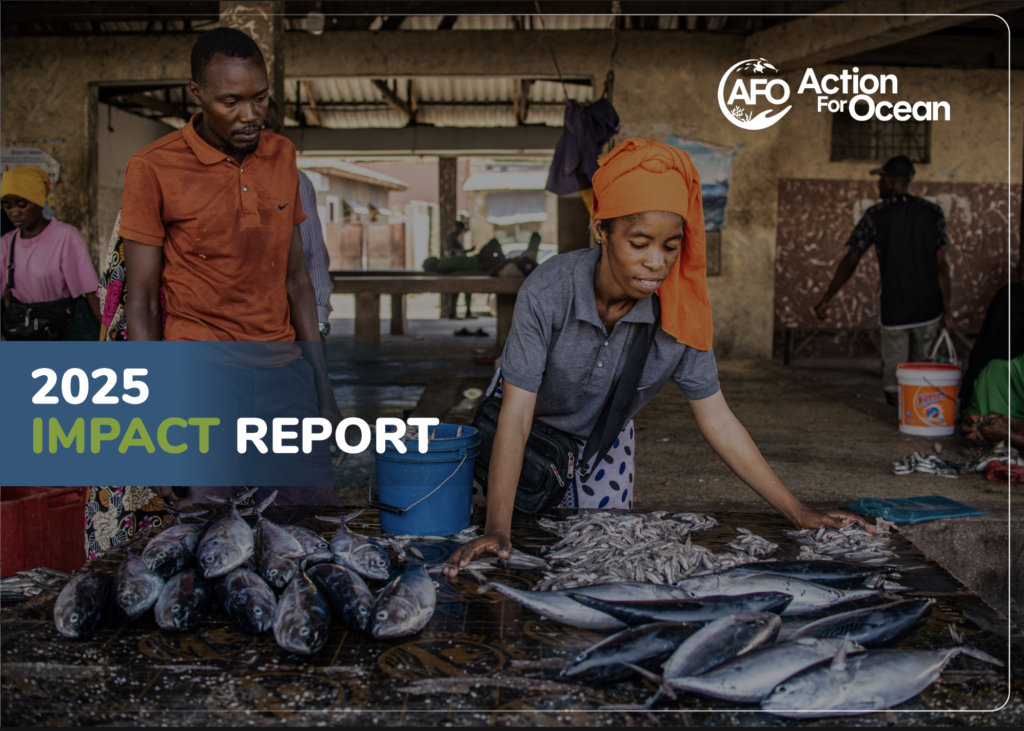
In 2025, Action For Ocean scaled a community led conservation model that links ecological recovery, local governance, and income resilience, so conservation becomes something communities can enforce, finance, and benefit from long term.
Across four priority seascapes in coastal Tanzania.
Five year total: 287,240 with 95% survival.
Linked to a 75% increase in octopus catch in Kilwa.
Up 45% versus pre closure earnings.
Expanded from 32 communities in 2025.
Nearly doubled, reducing trips needed to meet household income.
Reported compliance increases of about 70%.
VSLAs: 886 members, about 75% women.
About 40% accessed small loans for diversification and shock absorption.
About USD 21,420 generated, up 41% in monthly earnings.
Community built structures, about 70% survival estimate.
A locally run NGO facility, first of its kind in East Africa.
Fishers are now working less often, earning more in short bursts, because closure windows change biology and bargaining power.
Look for the Kilwa closure results and reinvestment details.
Savings groups mobilized tens of thousands of dollars locally. The interesting part is what people did with it: loans, diversification, and staying compliant while nature rebounds.
Check the VSLA and CLEAR Model sections.
AFO’s Tanzania DiveLab and our locally operated PADI Educational Facility turn underwater access into conservation infrastructure and a career pathway.
Look at what the future of the ocean looks like.
The report describes years of readiness: governance, monitoring, and institutions that can hold benefit sharing over time. The certification pathway is a story in itself.
Look for Kaboni Yetu and certification stages.
Data champions are now collecting catch and effort data and using it for local decisions, a small detail with a big system change.
See how enforcement and data reinforce each other.
2026 is framed as a transition year: focus on priority seascapes, stronger MEL and data systems, diversified finance, and talent pipelines to deliver at scale.
The PDF lays out the direction of travel.
Tap each theme for a short summary, then jump to the PDF for the full evidence trail.
Mangrove restoration and protection are embedded in local institutions, aiming to unlock climate finance and durable community benefits. The report emphasizes cumulative results over five years and progress toward blue carbon certification.
The report describes strengthening local institutions, including BMUs and CFMAs, through leadership, statutory roles, financial management, communications, and data use, so communities become the first line of fisheries management.
Temporary closures, with inclusive consultation and consent, reduced pressure and made recovery visible. The report links closures to both biological changes in size and abundance and locally retained financing streams, with levies reinvested in governance.
AFO’s DiveLab and PADI Educational Facility milestone are positioned as a shift away from reliance on external expertise: training pathways, local instruction, community divers, and coral restoration skills that communities can sustain.
VSLAs, seaweed farming, and market linkages are used to reduce pressure on fisheries. The report frames the blue economy pathway as the mechanism that makes compliance and stewardship economically viable over time.
“The catch from just five days now sustains my household longer than when I used to fish every day for uncertain catches.”
Quote highlighted in the report’s reef closure impact narrative.
In 2025, community led marine protection in Tanzania delivered measurable ecological recovery and locally retained income, while building governance, finance, and technical capacity to sustain it.
287,240 mangroves restored. 69 communities in co-management across Tanzania’s coast. None of it happens without people like you.