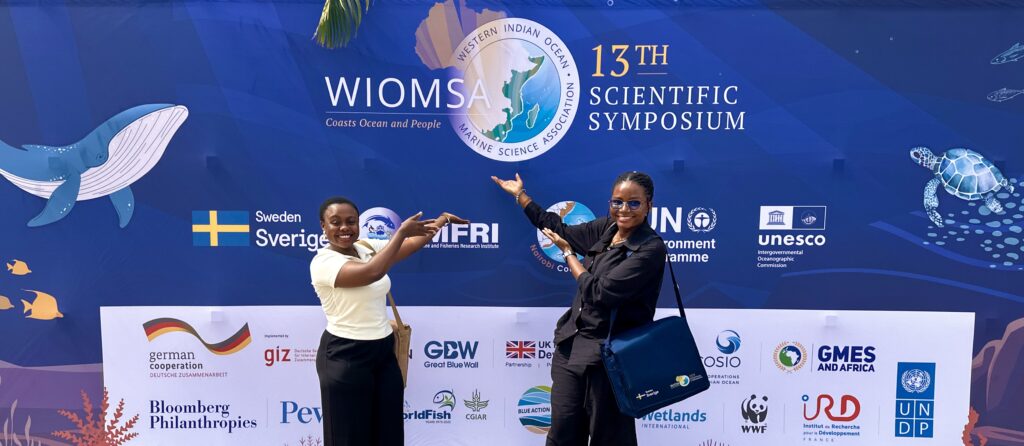
The 2025 Western Indian Ocean Marine Science Symposium in Mombasa offered something rare in the conservation sector: clarity. Not the soft, convenient kind that fits easily into strategy documents, but the kind that demands honesty about what’s working, what’s stalling, and what must fundamentally change if we want ocean conservation in the Western Indian Ocean (WIO) to match the scale of the crisis.
For Action For Ocean (AFO), this was a proving ground.
A youth-led Tanzanian organization standing on one of the region’s biggest scientific stages is not something that used to happen. But AFO didn’t arrive with a theory. We arrived with evidence. With lived experience. With models forged in coastal villages, not boardrooms. And by the end of the five days, the takeaway was unmistakable:
When communities lead and science supports, conservation becomes real, resilient, and scalable.
WIOMSA 2025 became a mirror for the region, and AFO stood in that reflection as part of the future, not the periphery.
Matumbawe Hai: A Model That Rewires How Coral Restoration Is Done
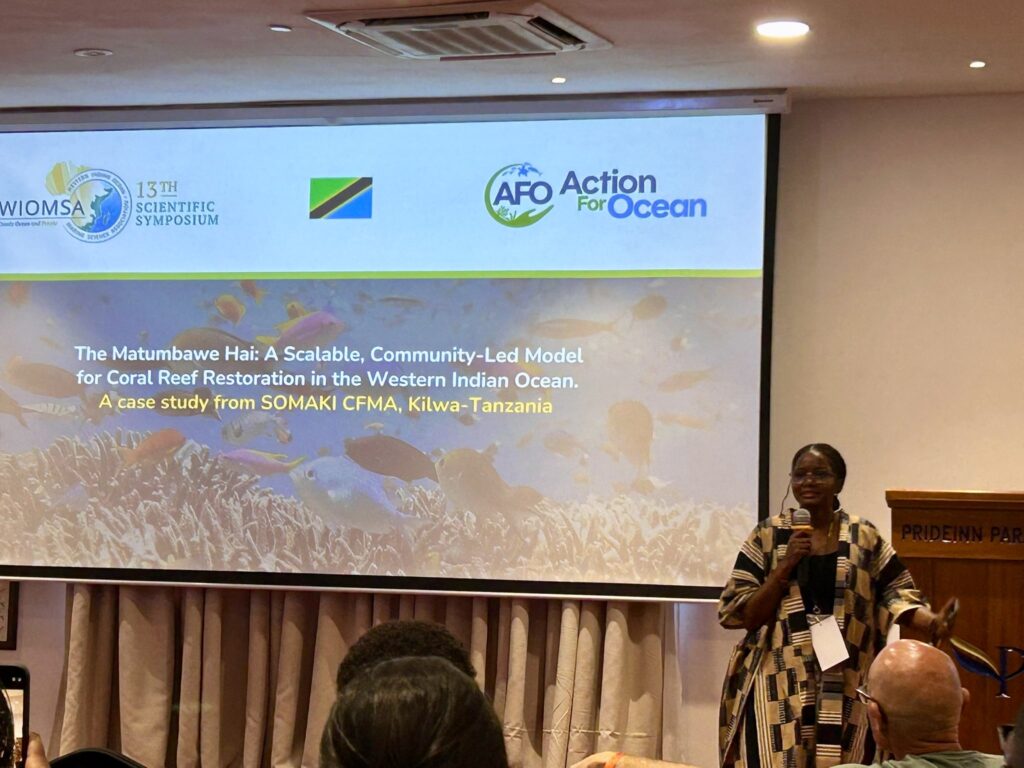
When Esther Mhamila, AFO’s Conservation Program Manager, stepped onto the WIOMSA stage to present Matumbawe Hai, the room leaned in not because coral restoration is new, but because this approach is different.
It doesn’t rely on external expertise.
It doesn’t crumble when funding cycles end.
It doesn’t separate ecosystems from livelihoods.
Matumbawe Hai integrates all of its governance, restoration, livelihoods, VSLAs, leadership training, youth engagement, eco-tourism into one community-anchored system. It’s conservation built with the people who depend on the reef, not around them.
Esther said it plainly:
“With the challenges we face from climate change, coral reef restoration is no longer optional. But it must be done in a way that puts people at the center.”
That line traveled across the symposium because it spoke to the gap the region has struggled with for years: high-cost, low-ownership restoration projects that collapse the moment the funding ends.
Matumbawe Hai showed a different path, one rooted in reality, in dignity, and in long-term impact.
The Tanzania Dive Lab: Breaking Open the Door to Underwater Science
Ask any young African scientist what stands between them and a career in marine science, and the answer is predictable: Access.
Training is expensive.
Certifications are out of reach.
Underwater experience is rare.
Representation is limited.
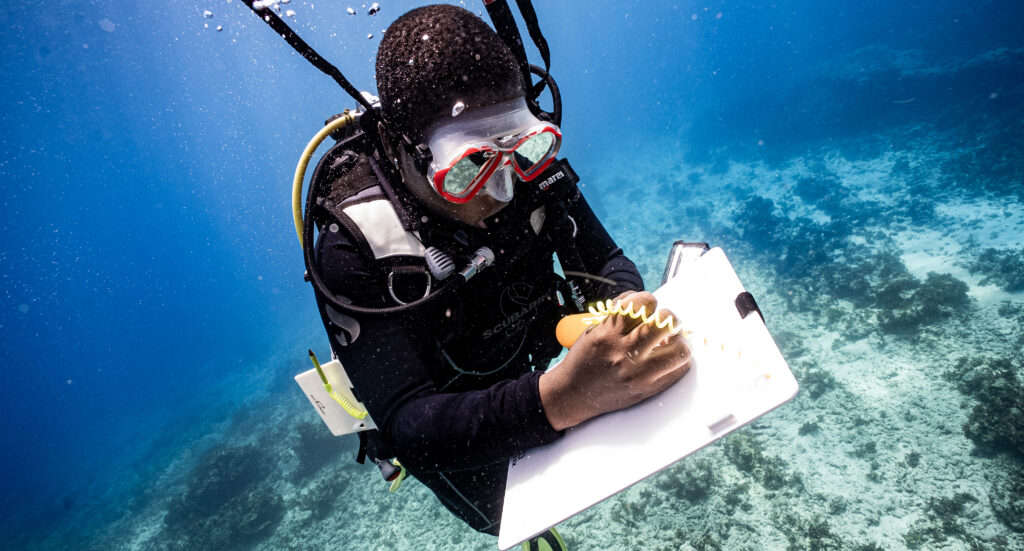
So when Evlyne Peter, AFO’s Divelab Co-ordinator presented The Tanzania Dive Lab, it struck a nerve across the Early Career Ocean Professionals (ECOP) community.
This program is not simply training divers, it is creating opportunity infrastructure.
Diving. Underwater research. Storytelling. Documentation. Professional development. A full pipeline built for the next wave of African Conservation Leaders.
Then Nancy Iraba, AFO’s Technical Advisor, drove the point home in her talk “What’s Stopping ECOPs from Diving In?” with one line that captured decades of exclusion:
“Passion has never been the problem. Access has.”
That moment reframed the conversation.
AFO isn’t just filling a skills gap we are rewriting who gets to participate in ocean science in the WIO.
Turning Science Into Something People Can Use: AFO’s Exhibition Booths
There’s a reason AFO’s booths became one of the most visited corners of WIOMSA.
People were looking for something real, not just data, but meaning.
- John Leonard — Monitoring & Evaluation
He showed how MEL becomes a practical tool for resilience when it’s built for communities, not just donors. His message was simple: if data doesn’t improve people’s lives, it’s just numbers. - Alex Mafuru — Seascape Conservation & Carbon Pathways
His work on mangroves and voluntary carbon markets hit at the region’s future linking ecological protection with income generation for coastal families. Conservation becomes stronger when it pays fairly.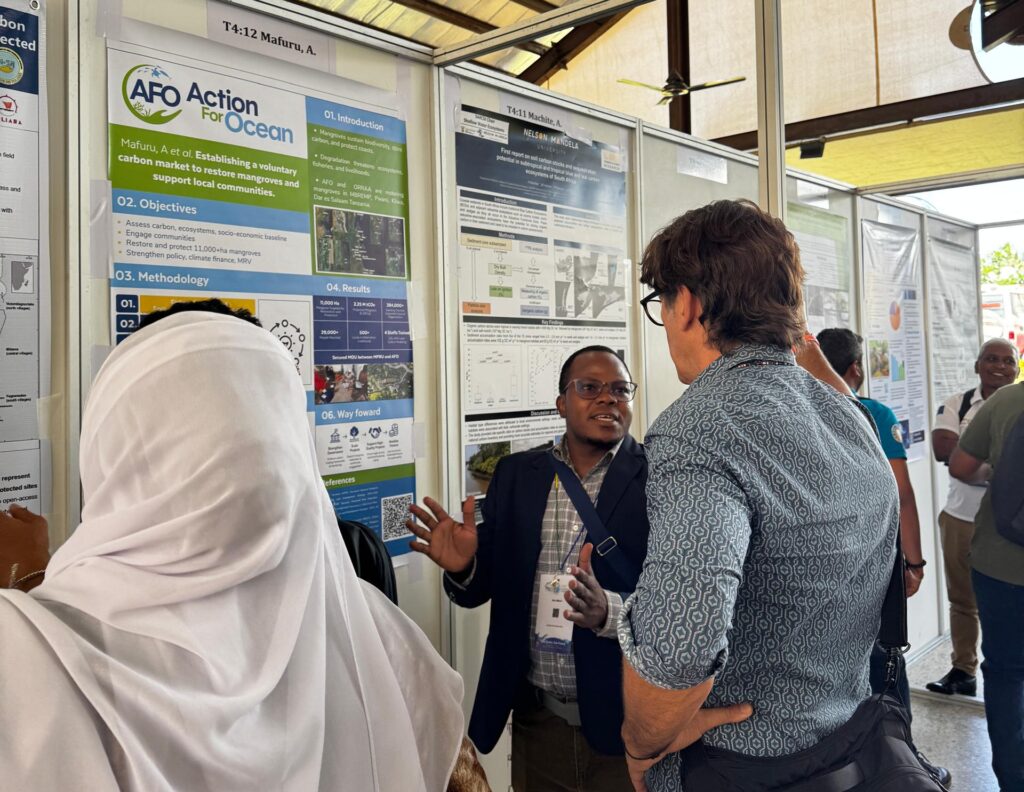
- Hosea Songo — Coastal Ecology
He translated the science behind tidal pools and seagrass ecosystems into something people could connect to. How they buffer acidification. How they protect biodiversity. How they support daily livelihoods.
All three booths carried the same undercurrent:
Science becomes powerful when it’s usable, understandable, and connected to the rhythm of local life.
Collaboration Over Competition: A Lesson From the OCEAN Grants Network
WIOMSA isn’t only a space for science, it’s a space for alignment. Through the OCEAN Grants Program sessions, AFO and other regional partners compared insights, frustrations, and breakthroughs.
That’s where the value of collaboration became obvious.
Organizations like COBEC and COMRADE weren’t competitors, they were missing links. Their challenges mirrored ours, their breakthroughs solved pieces of puzzles we have been carrying.
Esther captured it perfectly:
“The silo approach will never work in conservation. Real impact is only possible when we break barriers, share knowledge, and build solutions together.”
That line should be written at the entrance of every conservation funder in the region.
When Communities Lead, Everything Changes: The Marine Leaders Hub
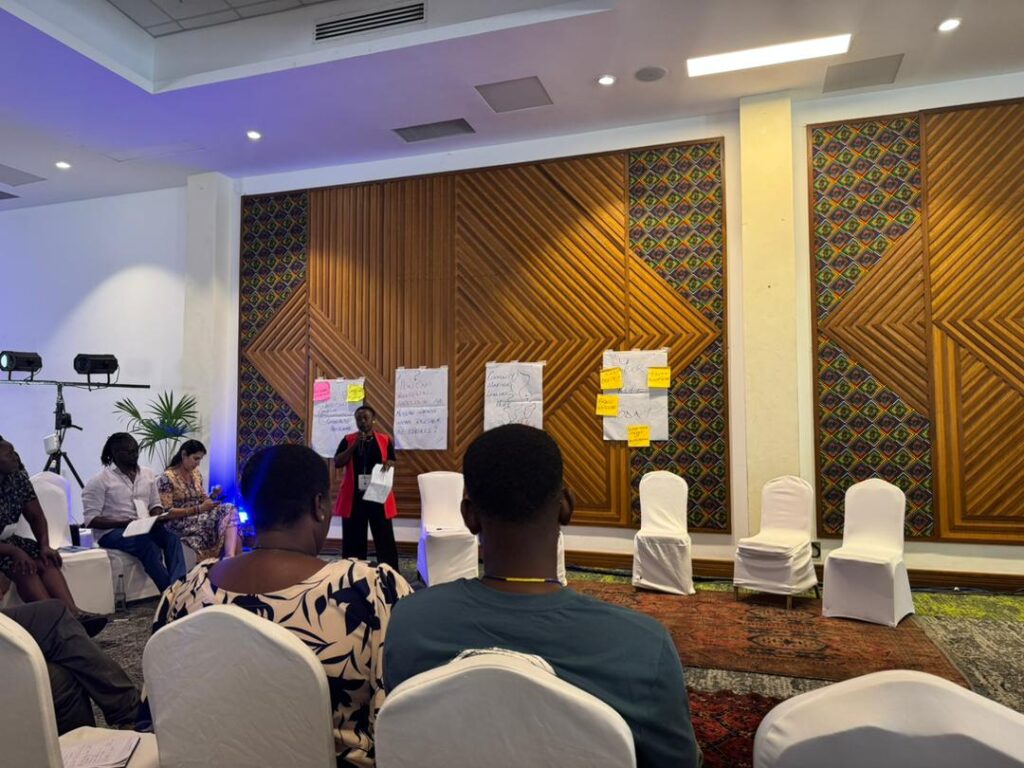
AFO’s Livelihood Manager, Imelda Ilomo, co-facilitated the WIOMSA Community Marine Leaders Hub, a space built with Maliasili to center the voices that conservation often sidelines.
Fishers. Elders. Women. Youth.
Not as participants, as co-designers.
They mapped solutions.
They shaped priorities.
They questioned assumptions.
They used art, story, and memory to explain what textbooks often fail to capture.
This is what inclusion looks like when done with integrity:
Communities defining conservation, not being informed about it.
What WIOMSA 2025 Made Unmissably Clear
Across every panel, booth, and discussion, the same truth surfaced:
Conservation without communities collapses. Conservation with communities scales.
AFO’s work across programmes isn’t a theory. It’s practice. It’s proof. It’s scalable. And it answers the twin challenge the region faces: restoring ecosystems and improving lives.
The WIO doesn’t need more pilots.
It needs models that last.
Models that replicate.
Models that honor the wisdom that already exists in coastal communities.
This is what AFO is building.
AFO Is Ready to Scale. We are Looking for Partners Who Believe in People-Powered Conservation.
WIOMSA was a milestone, but not the destination. The work ahead is bigger and urgent.
- Scaling coral restoration.
- Expanding youth access to ocean careers.
- Growing climate-resilient livelihoods.
- Strengthening MEL systems.
- Building a generation of African ocean leaders.
The models are tested.
The demand is clear.
Communities are ready.
Now we are looking for partners who want to back bold, community-anchored change.
This is the moment to support a movement that’s already reshaping the future of the Western Indian Ocean.
Couldn’t Attend WIOMSA? Experience It Through Our Lens
Key AFO presentations; including Matumbawe Hai, the Tanzania Dive Lab, and OCEAN Grants engagements are available on our YouTube channel.
Watch. Question. Learn. Act.
The ocean needs all of us.