Reflection on the Honeyguide TZ visit · Community Marine Conservation Series · March 2026
Tanzania’s Wildlife Management Areas have spent two decades wrestling with the same existential challenge now confronting coastal communities managing the ocean: how do you build conservation that outlasts the donor? A visit to Honeyguide Foundation’s work suggests the land already holds answers the sea urgently needs.
There is a question that haunts conservation work across East Africa, can Beach Management Units survive without donors? The answer, at present, is mostly no. Like many BMUs operating along Tanzania’s coastline, the organisations responsible for governing Collaborative Fisheries Management Areas (CFMAs) , the marine equivalent of a Wildlife Management Area(WMAs), depend almost entirely on external funding to keep the lights on, rangers patrolling, and conservation work happening. The moment donor support dries up, operations stall. This is not a new problem. It is a strikingly familiar one.
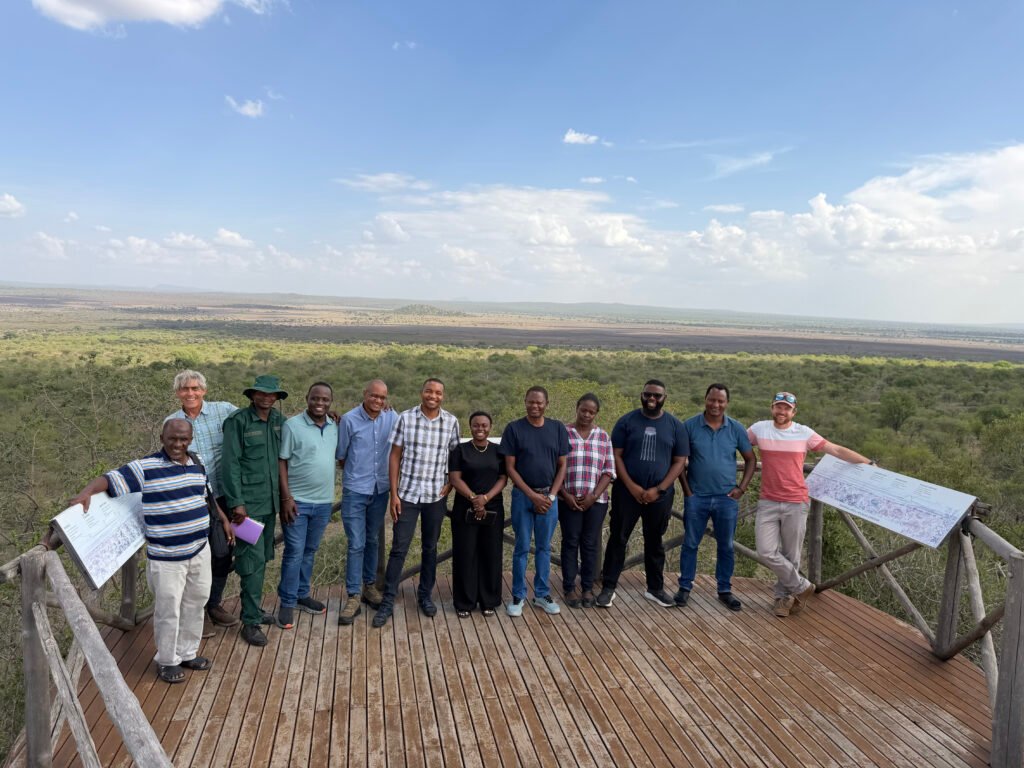
A recent visit to Honeyguide Foundation, the Tanzanian NGO that has spent nearly two decades turning 13 Wildlife Management Areas into self-reliant “social enterprises” offered a striking and timely mirror. The challenges that once crippled WMAs in the bush are precisely the ones now constraining marine conservation governance on the coast. And crucially, some of the solutions forged over years of trial and failure in northern and southern Tanzania may be the most instructive roadmap available to those building the next generation of CFMAs along the Western Indian Ocean.
The Parallel Crisis: Dependency on Land and Sea
Tanzania’s WMA framework, officially launched in 2003 and granting communities legal management rights from 2006, began as a bold devolution of wildlife governance. The premise was simple: when local communities own their wildlife and derive real income from it, they will protect it. But the execution revealed a structural fragility that should feel immediately familiar to anyone working on coastal marine governance. Research and Honeyguide’s own financial analysis found that 21 out of 24 WMAs are in financial distress, unable to generate the roughly $570,000 annually needed to sustain operations without external subsidies. Anti-poaching patrols alone can consume 60–75% of a WMA’s entire budget. The moment donor support falters as it did catastrophically during COVID-19 operations, compliance, and community trust collapse together.
Beach Management Units and their CFMAs face an almost identical structural problem. Research on marine CBNRM in Tanzania’s coastal districts confirms that BMUs though they have strong community support emerged, persist, and scale almost entirely through government-led and donor-led initiatives. The internal revenue-generating capacity is either absent or too fragile to sustain the institutional load. The challenge is framed this plainly: organisations that cannot survive a week without a donor are not yet conservation organisations in a sustainable sense they are project delivery vehicles.
| THE CORE CHALLENGE
Both WMAs and CFMAs share the same structural vulnerability: conservation governance structures with community legitimacy but without the financial independence to act on it. The lesson from two decades of WMA experience is that external funding is not a foundation, it is scaffolding. The building underneath must be capable of standing on its own. |
Six Lessons from the Savanna for the Sea
The Honeyguide model refined across sites including Randilen, Burunge, Makame, and Enduimet WMAs offers a set of hard-won principles that translate with remarkable directness into the marine governance context. These are not theoretical prescriptions; they are operational conclusions drawn from communities that faced the same collapse-or-survive pressure that marine CFMAs are now navigating.
| LESSON 1
Treat conservation as a social enterprise, not a project Honeyguide’s foundational shift was reframing WMAs as community-owned social enterprises with governance boards, revenue targets, and operational budgets. CFMAs need the same reframe: a BMU is not a committee, it is the board of a marine enterprise whose product is ocean health and whose return is community prosperity. |
LESSON 2
Diversify revenue or accept fragility Successful WMAs combine photographic tourism, carbon credits, and sustainable hunting. No single stream is enough. CFMAs must look beyond fishing levies toward dive tourism, blue carbon, marine monitoring contracts, and eco-certification premiums. An ocean that only generates income from fish catches is as vulnerable as a WMA that only sells game drives. |
| LESSON 3
Governance is not background work, it is the work Honeyguide’s Governance Capacity Building Framework treats transparent leadership and equitable benefit-sharing as the primary mechanism for sustaining community investment. Without trust in revenue distribution, coastal communities will not defer livelihoods for conservation. Governance is the anchor. |
LESSON 4
Financial literacy is a conservation tool WMAs that now cover operational costs independently like Burunge, which has done so since 2021 got there through financial discipline: budgeting, reserves, transparent accounting. Training BMU leadership in financial management is as important as training rangers. |
| LESSON 5
Build for handover from day one Every Honeyguide tool is “built for handover” designed so communities own and sustain them without the NGO. This is the exact failure mode of many BMU programmes: they build capacity in the project, not in the community. CFMAs need support models that exit cleanly. |
LESSON 6
The community must see the benefit to protect the resource The foundational logic of WMAs is that communities protect wildlife when they profit from it. Burunge’s zero poaching record and 90% reduction in farm damage from elephants followed transparent revenue sharing. CFMAs that cannot demonstrate tangible community benefit will always struggle to enforce rules. Value precedes compliance. |
The Structural Comparison: WMAs and CFMAs Side by Side
The architectural parallels between WMAs and CFMAs are close enough to be instructive, and different enough to demand careful adaptation. Both are community-led governance mechanisms anchored in national legislation, both depend on revenue generation to sustain enforcement, and both are currently over-reliant on external support. But the marine environment introduces distinct complexities; the resource is mobile, invisible, and shared across boundaries in ways that a wildlife corridor is not.
| Dimension | WMAs (Wildlife) | CFMAs / BMUs (Marine) |
| Legal basis | Wildlife Conservation Act; WMA Regulations 2003/2012 | Fisheries Act No. 22 (2003); Fisheries Regulations 2009 |
| Resource ownership | Community land with devolved wildlife use rights | Co-management with government; no equivalent community title |
| Revenue model | Tourism, carbon, hunting — increasingly diversified | Primarily levies on fishing; limited alternative revenue |
| Donor dependency | High; 21 of 24 WMAs in financial distress | Very high; most BMUs cannot operate without external funding |
| Governance capacity | Improving through GCBF, BEST, and GIA frameworks | Variable; limited standardised capacity-building tools |
| Resource visibility | Wildlife largely visible; spatial management tractable | Fish stocks invisible, migratory; boundaries harder to enforce |
| Blue carbon potential | Terrestrial carbon markets maturing | Mangrove and seagrass carbon largely untapped; high potential |
| Tourism linkage | Strong; proximity to national parks drives revenue | Emerging; dive tourism and marine ecotourism under-developed |
Where Marine Conservation Has an Edge
The comparison is not entirely unfavourable to the marine side. CFMAs and BMUs have assets that WMAs have spent years trying to develop. Tanzania’s coastline sits within a globally recognised biodiversity hotspot, and the Western Indian Ocean’s reef systems, seagrass beds, and mangroves command serious international attention both from conservation funders and, increasingly, from blue carbon markets. The same premium dive tourism demand that Kilwa Masoko is beginning to attract is a financial lever that coastal CFMAs can pull in ways that many inland WMAs cannot.
Mangrove carbon represents a significant untapped revenue stream for coastal CFMAs. Tanzania holds among the most extensive mangrove systems in the WIO, and blue carbon crediting mechanisms are maturing rapidly. A CFMA that successfully protects a mangrove system could generate carbon revenue comparable to what northern WMAs like Makame generate from photographic tourism without the infrastructure investment. This is not yet happening at scale, but the pathway is clearer now than it was five years ago.
| “We do not expect to be around forever; we do not want these WMAs dependent on us, so we need to include the element of sustainability in our model. If we bring conservation to the table, we must back it with a fail-safe model that minimises risk for our local partners.” Damian Bell, CEO — HONEYGUIDE FOUNDATION |
Honeyguide’s ethos; investing $600,000 to $1 million per WMA over three to five years specifically to achieve financial independence represents a fundamentally different theory of change from most marine CBNRM support programmes, which tend to fund ongoing operations indefinitely. The goal is not continued support; the goal is exit. Leaving behind a community-owned enterprise that generates enough from tourism, carbon, or other revenue streams to fund its own governance, enforcement, and benefit-sharing without requiring another project cycle. That model, adapted for the marine context, is precisely what sustainable CFMAs need.
What a Honeyguide-Equivalent for Marine Tanzania Looks Like
The WMA sector took years to develop what Honeyguide has built: practical governance assessment tools (the GIA toolkit), financial planning frameworks (the Business Enterprise Sustainability Tool), and a theory of change centred on community social enterprises rather than conservation projects. The marine sector in Tanzania is largely still operating at the stage WMAs were in 2007; when Honeyguide was founded to address precisely the governance and financial gaps that left good communities with good intentions unable to sustain their conservation commitments.
An institution that did for CFMAs and BMUs what Honeyguide has done for WMAs would need to build structured governance capacity at the BMU level, develop marine-specific financial sustainability tools accounting for the blue economy’s distinct revenue streams, and hold the same unwavering commitment to exit to building communities that are capable of running their own affairs without permanent NGO support. It would need to treat coastal communities not as beneficiaries of conservation, but as its primary architects and economic owners. That is the direction AFO has taken course in the past couple of years.
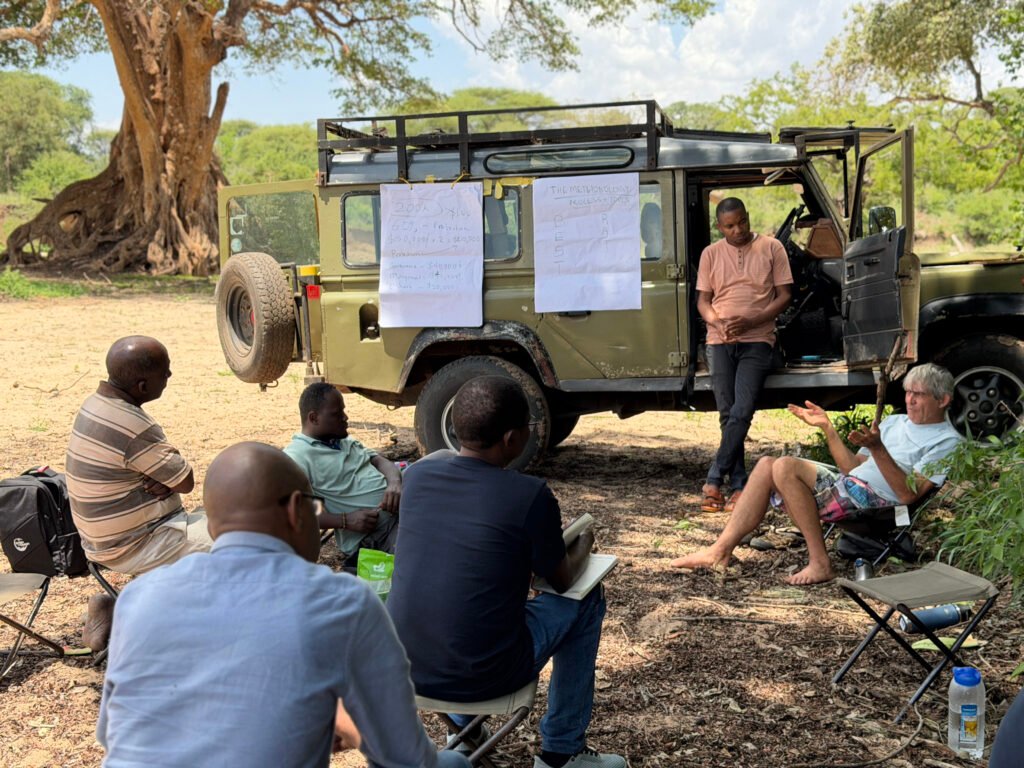
The visit to Honeyguide’s work was not a lesson in how to copy a model. It was a reminder that the foundational questions; who owns the resource, who benefits from protecting it, and who is accountable for its management are the same on land and at sea. Tanzania has already done the hard, slow work of answering those questions for its wildlife. The coast now has the advantage of learning from that experience rather than repeating it.
| THE ROAD AHEAD
Sustainable CFMAs will not emerge from better donor management. They will emerge from coastal communities that own their marine resources in a meaningful economic sense that generate income from protecting the ocean, and govern that income transparently enough to build the community trust that makes enforcement legitimate. The WMA experience says this is possible. It takes time, structured investment, and the discipline to build for handover. |